Table Of Content
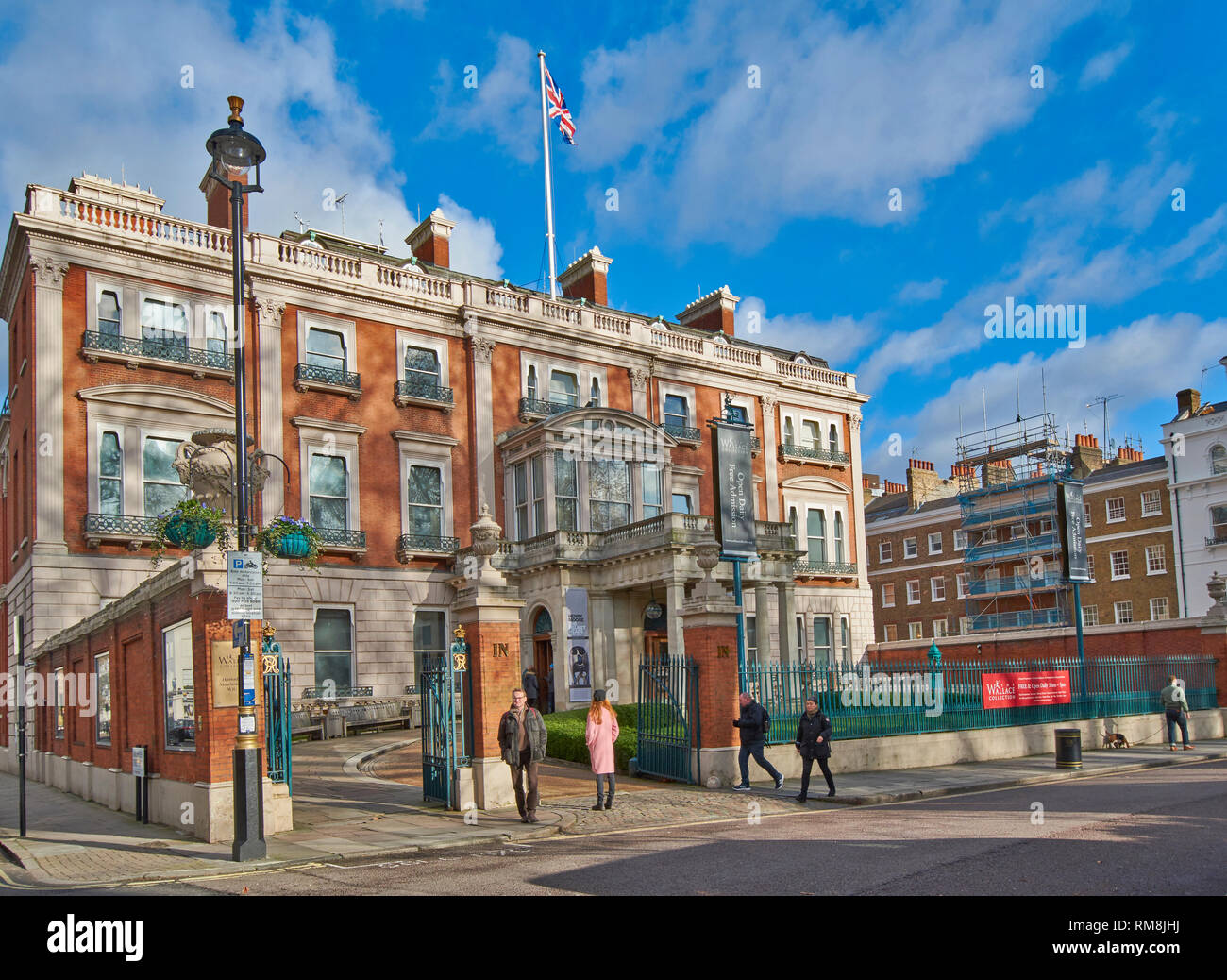
His purchases defined what you see at the Wallace Collection today. But it was the third marquess who was the first to show a real interest in art. He acquired the important 17th century Dutch paintings and much of the French furniture and Sevres porcelain. Each of the rooms devotes itself to a theme, for example the smoking room exhibits works of art from the medieval and Renaissance period. In this room the stand out feature is the preserved alcove, beautifully adorned with Iznic tiles inspired by the Middle East. The smoking room was constructed around 1872 as part of a larger refurbishment project under the guidance of the architect Thomas Benjamin Ambler.
The Wallace Restaurant is a London dining experience just waiting to be discovered.
Throughout the generations, the interest and knowledge of the art collection grew. The third Marquess of Hertford led the way, using the events of the French Revolution to his advantage in order to amass a great selection of French art, including ornate pieces of French furniture. The Wallace Collection, a former townhouse, is now an impressive public museum housing a world famous art collection.
Exploring Riesener's Furniture
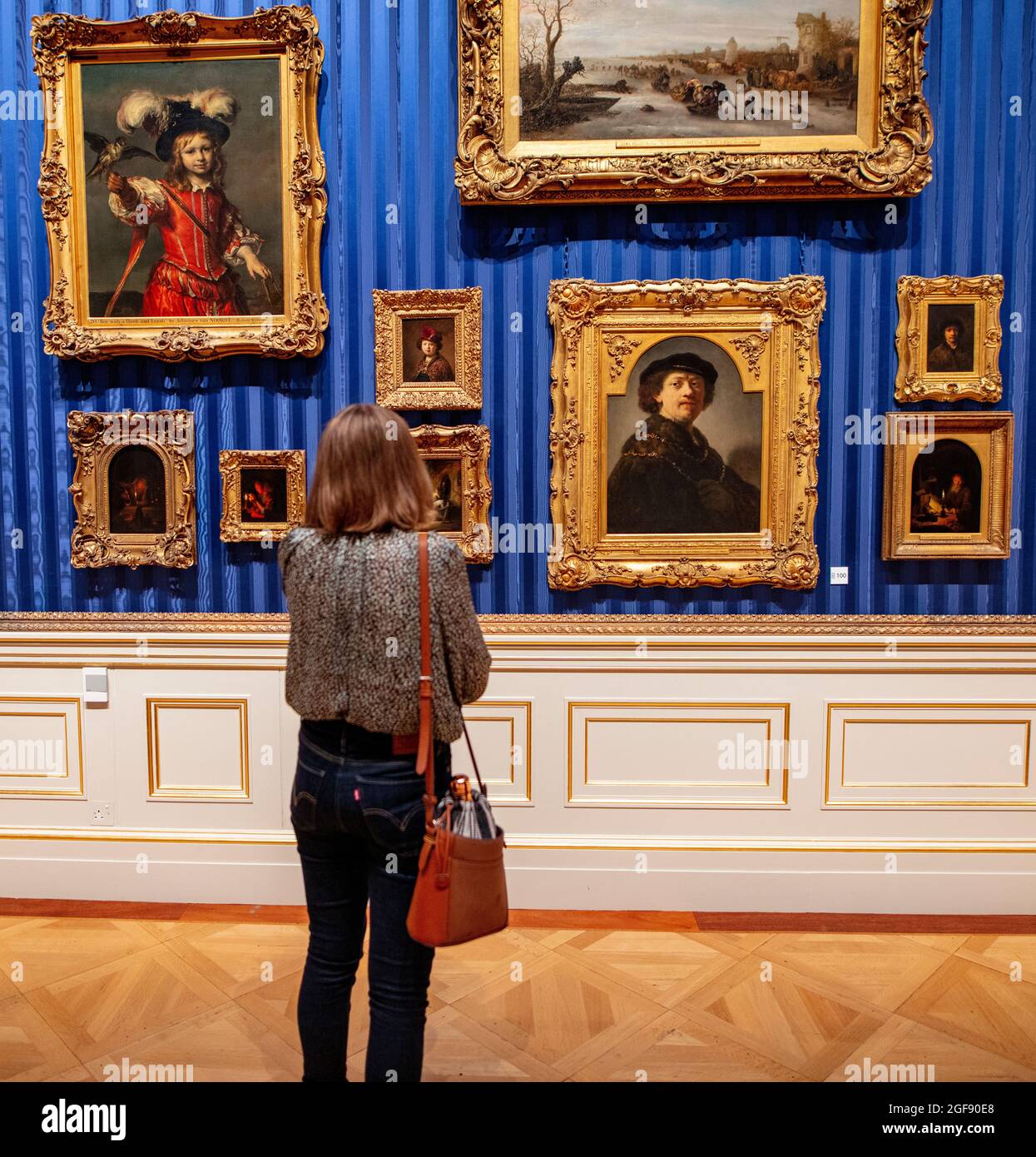
The museum lacks the standard white or gray walls you’re used to seeing in a museum. Instead, the colorful wallpaper, gilded frames, and porcelain compete for your attention. It’s a perfectly preserved in situ collaboration of art and period settings.
Exploring Reynolds's Paintings
The Wallace Collection is particularly notable for its 17th- and 18th-century French and British paintings and sculpture. There are also works by Dutch, Flemish, Italian, and Spanish artists, as well as a large holding of paintings by the 19th-century British artist Richard Parkes Bonington. A French furniture exhibit includes a number of important pieces, and there are many rare clocks.
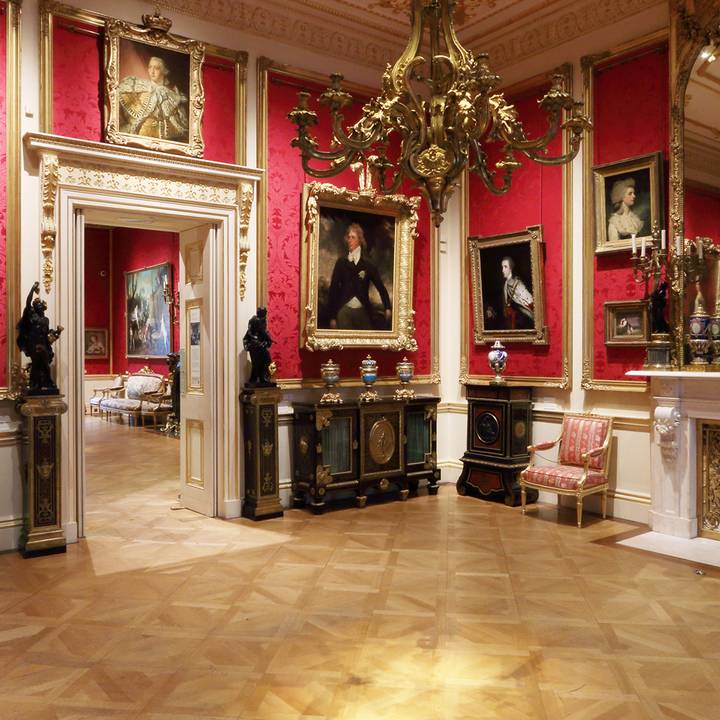
The Back State Room is today dedicated to the patronage of King Louis XV (1715–1774) and his mistress, Madame de Pompadour. It displays some of the prominent examples in the Wallace Collection of art in the rococo style. Sir Richard Wallace used the Back State Room to entertain guests at Hertford House. During his lifetime it had wooden boiserie panelling on the wall; the great chandelier, by Jacques Caffiéri, dating from 1751, remains in the room. Julie Amelie Charlotte Castelnau, known from 1871 as Lady Wallace is best known today for her "bequest to the Nation" of about 5,500 artworks that resulted in the Wallace Collection, which opened in her marital home 13 years after her death.
Timeline
The Oriental arms and armour in the Wallace Collection were largely collected by the 4th Marquess of Hertford in the 1860s, the last decade of his life. Like many of his contemporaries, Sir Richard Wallace used this material to bring Oriental exoticism, as it was then considered, into his fashionable London house. The Oriental Armoury was displayed on the first floor of Hertford House.
Her bequest was almost certainly in fulfilment of the wishes of her late husband Sir Richard Wallace, 1st Baronet, who together with his father and grandfather, the 3rd and 4th Marquesses of Hertford, had amassed the majority of the collection. Louis XVI furniture is characterized by elegance and neoclassicism, a return to ancient Greek and Roman models. Much of it was designed and made for Queen Marie Antoinette for the new apartments she created in the Palace of Versailles, Palace of Fontainebleau, the Tuileries Palace, and other royal residences. The finest craftsmen of the time, including Jean-Henri Riesener, Georges Jacob, Martin Carlin, and Jean-François Leleu, were engaged to design and make her furniture. Wallace Collection, in London, England, a collection of fine and decorative artworks bequeathed to the British government in 1897.
Visitor’s Guide To London’s Stunning Wallace Collection
The armoury includes choice European arms and armour, as well as Asian material. The Sèvres porcelain includes representatives of each phase and style of the 18th century. Among the miniatures is a self-portrait of Hans Holbein the Younger. The fine, eclectic Wallace Collection was built up by the Seymour-Conway family, marquesses of Hertford, during the 18th and 19th centuries.
Jean-Honoré Fragonard’s The Swing at the Wallace Collection - Tatler
Jean-Honoré Fragonard’s The Swing at the Wallace Collection.
Posted: Mon, 23 Jul 2018 07:00:00 GMT [source]
The Wallace Cafe and Restaurant
A great philanthropist, Wallace was knighted in 1871 for his charitable services during the Siege of Paris. Before leaving Paris, he presented the city with fifty cast-iron fountains, known as ‘Les Wallaces’, which provided free clean drinking water to the public. In 1872 he brought over to London many of the works of art inherited from Lord Hertford, to which he added important collections of medieval and Renaissance objects and European arms and armour. Several of the weapons here were made for European rulers, including Louis XIII and Louis XIV of France and Tsar Nicholas I of Russia.
She chose Boucher to paint her and became a generous patron to him. The artist epitomized the inimitable style of mid 18th century French art. This beautiful Boucher painting depicts Madame de Pompadour, who was the official mistress of Louis XV. When the king died, the painting was sold off at auction and purchased by Richard Wallace.
The Laughing Cavalier is the second most famous painting in the Wallace Collection. It was painted by Franz Hals, a preeminent Dutch Golden Age painter. But he did recognize his illegitimate son, Richard Wallace. From 1870, Hertford House was the home of Sir Richard Wallace and Lady Wallace whilst in London.
The Wallace Collection museum experience is much more refined and especially so when you take a break in the cafe and restaurant in the light filled central atrium. Experience a world of art through our exhibitions and displays. Sir John Edward Arthur Murray Scott, 1st Baronet of Connaught Place (1847–1912) was a British art historian and collector. He is best known for his role in the formation of the Wallace Collection.
In 1890, he bequeathed his property to his widow Lady Wallace who, on her death seven years later, left the works of art on the ground and first floors of Hertford House to the British nation. She left most of the rest of her property, which included many fine works of art, to her secretary John Murray Scott. A friend of the Prince Regent, later King George IV, he acquired important 17th-century Dutch paintings, French furniture, gilt bronzes and Sèvres porcelain. Between 1897 and 1900 the former private residence was converted into a public museum. Galleries replaced the stabling, coach-houses and smoking room as well as some private rooms on the first floor.
It was the beginning of the French Baroque movement in furniture and design, and also marked the beginning of the Rococo movement, which spread to Italy, Bavaria and Austria by the mid-18th century. The nearest tube stations are Bond Street (Central Line), Baker Street (Bakerloo Line, Jubilee Line, and Circle Line), and Oxford Circus (Bakerloo Line, Central Line & Victoria Line). All are about 10 to 15 minutes away from the museum on foot. There’s also a lovely portrait by Elizabeth-Louise Vige Le Brun.


No comments:
Post a Comment